
Chase County Criminal Docket Searches
The public starting point is Kansas CaseSearch. Pick District as the court level. Then choose Case Number or Party Name, set County to Chase County, and set Case Type to Criminal. Citation Number works as a search type too. A precise case number beats a broad name search. The same names show up across Kansas counties again and again.
No account is needed for basic public searching in the current interface. Older Fifth District instructions still reference registration and legacy portal addresses. Expect some conflicting directions while the statewide transition plays out.
- Choose District and the narrowest search type.
- Enter the case number, party term, business term, or citation number.
- Set County to Chase County and Case Type to Criminal.
- Complete the human check and inspect the matching public case information.
- Compare a future setting with the Fifth District calendar.
- Call or visit the clerk for confirmation, terminal access, or an official copy.
Getting a challenge, blank result, or error? Try a normal browser with JavaScript enabled. Confirm the District and Chase filters, then check the Kansas Courts status page. Skip the unofficial records aggregators entirely.
CaseSearch Fields for Chase Criminal Cases
The portal offers more than a keyword box. Optional filters include date of birth and filing-date ranges, though a case number plus the county filter usually clears up ambiguity without a personal identifier. The Chase option uses CS in the application. The current CaseSearch application shows the controls a Chase County criminal docket search relies on.
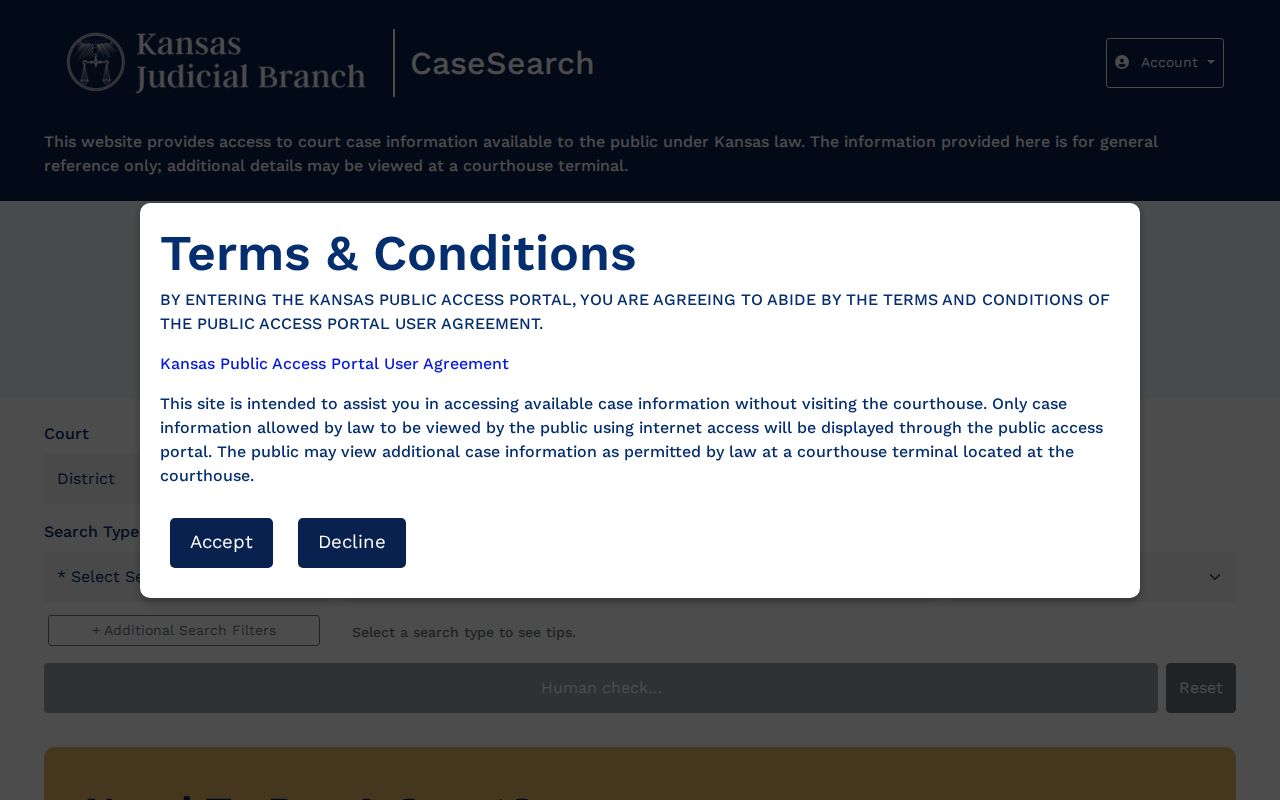
The sequence matters. Pick the court level, the search type, and the search term, then apply the Chase County and Criminal filters and complete the human check.
Criminal Dockets: What They Show
Think of a register of actions as a structured case history. It is not a narrative report. What appears online varies by document and access rule. The calendar is narrower still, listing scheduled events without proving a hearing happened or any outcome followed.
| Case number | Observed numbers use CS-YYYY-CR-NNNNNN; confirm uncertain numbers with the clerk. |
|---|---|
| Charges | Filed offense entries and later amendments may appear. |
| Roles | Public fields may identify prosecutor, defendant, and attorneys where rules permit. |
| Settings | First Appearance, Arraignment, Pretrial Conference, Plea Hearing, Sentencing, Bench Trial, and Probation Violation occur on the calendar. |
| Filings | Motions, orders, journal entries, pleas, dispositions, and notices may be indexed. |
| Outcome | Read the actual disposition or judgment; a scheduled Disposition setting is not the result. |
Reading Chase Criminal Case Numbers
A Chase calendar entry appears in a display like CS-2026-CR-000006. CS marks the Chase court. The four digits give the filing year. CR signals a criminal matter, and the final digits separate one file from the next. Treat this as an observed format rather than a published code legend.
- CS
- Chase County identifier shown in current district entries.
- YYYY
- Filing year, not necessarily the year of alleged conduct.
- CR
- Criminal case-type code.
- NNNNNN
- Sequential numeric part of the file number.
Skip the shorter examples in older Smart Search guides.
Criminal Case Stages on the Docket
Chase County labels mark distinct procedural moments. A First Appearance is not an Arraignment, and an Arraignment is not a trial. A Pretrial Conference deals with preparation and scheduling. A Plea Hearing concerns a plea, while a Sentencing entry only names a future setting and says nothing about the sentence itself.
The order can shift. Motions, continuances, and probation proceedings may intervene at any point. "On PV warrant" points to a probation-violation warrant context, not to a proven violation or any ruling.
Chase Criminal Filings in FY2024
The Kansas Judicial Branch's FY2024 filing report offers local context without naming case participants. Chase County recorded 44 felony filings and 38 misdemeanor filings.
Filing totals are not people counts, guilt findings, or the live pending docket. Disposition statistics answer a different question and still cannot replace a case-specific entry.
Chase County Criminal Docket Courts
Felony, misdemeanor, criminal-setting, and probation-violation files all belong to Chase County District Court, part of the Fifth Judicial District along with Lyon County. Judges may sit across the district. That means a judge's name never moves a Chase case elsewhere. Clerk Jenna Gibb holds the records.
| Office | Contact | Role |
|---|---|---|
| District Court Clerk | 300 Pearl St., P.O. Box 529, Cottonwood Falls, KS 66845; 620-273-6319 | Docket, filings, public terminal, copies, and payment routing |
| County Attorney | P.O. Box 637; 620-273-6359 | Prosecution and diversion, not the full docket |
| County Sheriff | 301 S. Walnut; 620-273-6313 | Law enforcement and detention records, not the docket |
| Cottonwood Falls Municipal Court | City channel | Municipal ordinances and city citations |
| U.S. District Court, Topeka | PACER and federal counter | Federal files outside Kansas CaseSearch |
When Chase Criminal Documents Are Missing
A missing attachment does not mean no filing exists. Rule 22 separates the public web portal from courthouse-terminal access. Public material may sit at the terminal even when it is not exposed online.
Call 620-273-6319. Stop at the clerk counter at 300 Pearl Street during its listed 8:00 a.m. to 5:00 p.m. weekday hours. Or mail a focused request to P.O. Box 529. Give the case number and the exact item sought. Ask about certification and current copy charges if you need an official copy. The documented Kansas Open Records Act request route may also apply, alongside court-record rules.
Access Rules for Criminal Dockets
Public access runs through Kansas Supreme Court Rule 22. Some material stays closed regardless. Expunged records, sealed files, certain investigation material, juvenile records, and protected data do not become public just because a related setting is listed. The Chase calendar displays sealed juvenile entries with role fields but no identities.
Public access has layers. The web portal shows information approved online. A courthouse terminal can show additional public material, while restricted records remain unavailable.
Rule 22 governs electronic access. K.S.A. 60-2617 addresses sealing and redaction.
A Chase County criminal docket is not a KBI criminal-history record. The calendar, sheriff file, diversion form, and court docket each serve distinct purposes. Use the Chase County docket search for public case lookup, then verify the official item with the clerk.
Clerk and Terminal Access in Chase County
The terminal inside the Chase County courthouse opens a door the internet does not. Rule 22 bars remote access to certain public case material. Yet that same material can sit on a terminal at the courthouse for any visitor to read. Ask for something concrete. A filed motion, a journal entry, a judgment. Naming the specific instrument helps. The clerk finds it fast and tells you whether inspection, a plain copy, or a certified copy is on the table.
A phone call works for confirming a case number and the right request path. Do not expect staff to read an entire docket aloud over the line. Mail suits anyone who cannot make the trip to Cottonwood Falls. Include a return address. Also give a way to sort out cost and scope. Screens sometimes go dark statewide. The Kansas Courts status page tells you whether the system is down or your query simply matched nothing. Once service returns, run the narrow search again.
Chase District Court lists fax numbers and court-services staff on its page. The Fifth District contact page steers public questions to the right department. Start there. Guessing that the County Attorney or Sheriff keeps the register usually wastes a day. Municipal ordinance cases belong to the issuing city. Federal matters go to the District of Kansas Topeka Division and PACER. Pick the right venue the first time. That avoids a false no-result and keeps your docket request with the office that can actually answer it.
The FY2024 criminal disposition report sorts outcomes into categories. The categories include guilty pleas, dismissals, diversion, jury trials, and trials to the court. Helpful context, yes. But those statewide categories say nothing about your particular Chase file. For a real answer, find the disposition entry on the case itself. Then find the judgment or journal entry if you need more. The County Attorney runs its own diversion route, entirely apart from the docket custodian. Filing a diversion application starts a program request. It does not prove diversion was granted. It does not prove completion either.
Read the calendar's attorney columns with the same care. Prosecutor, Defendant, and attorney links describe how a person connects to a scheduled event, nothing more. They do not show that anyone appeared. Counsel may have changed since the report was made. Compare the latest public case information with the filed event, then confirm with the clerk. A sealed label means what it says. Do not use visible role fields to guess at hidden identities or facts.
Court records are not the only local systems, and they are not interchangeable. Sheriff incident and detention records, County Attorney program materials, and KBI criminal-history products. Each answers a different question. None of them replaces the District Court's chronological register. Whatever clue first pointed you to a case. The District Court Clerk remains the final check on a filed charge, a motion, a disposition, or a certified copy. The clerk can also tell you whether the item you want is public at all.