
Chase County Civil Docket Searches
Start at Kansas CaseSearch and pick District. You can search by Case Number, Party Name, Business Name, or Party As Business Name. Choose Chase County under County. Set the category to Civil when that fits the matter, since Family and Probate or Mental Health are separate filters that should not be folded into one general Civil query.
- Select District and the most precise search type.
- Enter the case number, party name, or business term.
- Choose Chase County and the proper case-type filter.
- Use filing-date filters only when they help distinguish results.
- Complete the human check and read the public case information.
- Use the clerk or courthouse terminal for unavailable documents and certified copies.
Basic searching today needs no registration. Some older Fifth District directions still describe a registration workflow with legacy addresses. Treat those pages as leftovers from a transition, not proof that a public account is required now.
Chase Civil Filters Are Not Interchangeable
CaseSearch splits Civil, Family, and Probate or Mental Health into distinct buckets. The split matters most when a name search comes back empty. Contract, property, limited action, and small-claims files normally sit under Civil. Domestic matters use Family. Estate, guardianship, or mental-health matters use the combined Probate or Mental Health choice.
| Filter | Typical Chase use | Access caution |
|---|---|---|
| Civil | Regular civil, limited actions, small claims, and related matters | Documents depend on Rule 22 and eCourt availability |
| Family | Domestic-relations files | Some content may be confidential or restricted |
| Probate or Mental Health | Estate, guardianship, and related categories | Public access is case and document specific |
An empty portal result does not mean no case exists. Check the category and spelling first, then ask the clerk to locate the file.
Civil Dockets: What They Show
Think of the Chase County civil docket as an event index. It tells you what was filed and when. The full text of a pleading or order may not be there, so plan on a separate request for documents.
| Case number | The current calendar shows CS-YYYY-CV-NNNNNN for civil matters. |
|---|---|
| Parties | Plaintiff and defendant roles appear where public access permits. |
| Filings | Petition, answer, counterclaim, service return, motions, responses, and notices may appear. |
| Settings | Date, time, judge, setting type, role connections, and attorney fields may be listed. |
| Orders | Journal entries, judgments, dismissals, and post-judgment events may be indexed. |
| Copies | An online entry is not a certified copy; certification comes from the clerk. |
A Motion Is Not a Chase Judgment
One entry on the Chase calendar reads Motion for Default Judgment. It carries a September 2026 date and time, a CS-2024-CV case number, a judge, Plaintiff and Defendant roles, and an attorney column. The private caption does not carry over to the public listing.
Read the event verb. A motion is a request set for consideration. The calendar does not reveal whether the judge granted, denied, continued, or resolved it by agreement.
A motion entry is a request. The ruling arrives later, in the court's order or journal entry, so look for that docket event before drawing conclusions. The same caution applies to settlement conferences, hearings, and motions to dismiss. A setting shows what is scheduled, not the result.
What Cases Fill the Civil Docket
Chase County District Court handles the county's general civil load: ordinary civil actions, domestic matters, probate or mental-health categories, small claims, and Chapter 61 limited civil matters. Municipal court is not a substitute for any of that. Its dockets cover a far narrower range.
- Regular civil claims involving contracts, property, damages, or other disputes.
- Limited civil and Chapter 61 matters, including local eviction procedures.
- Small claims handled through the District Magistrate Judge process.
- Family and domestic matters searched with their own category.
- Probate, guardianship, and mental-health matters subject to specific access rules.
Files mix public and restricted material. Seeing a caption or setting does not make every attachment public.
Small Claims at the Chase Counter
The Fifth District's Chase small-claims page lays out a process with local quirks. Money or property claims must stay under $10,000. The clerk hands you the petition form. You state the claim, sign it, pay the fee, and give a service address. The District Magistrate Judge hears the evidence. Either side may subpoena witnesses. That is how Chase County small claims work at the counter.
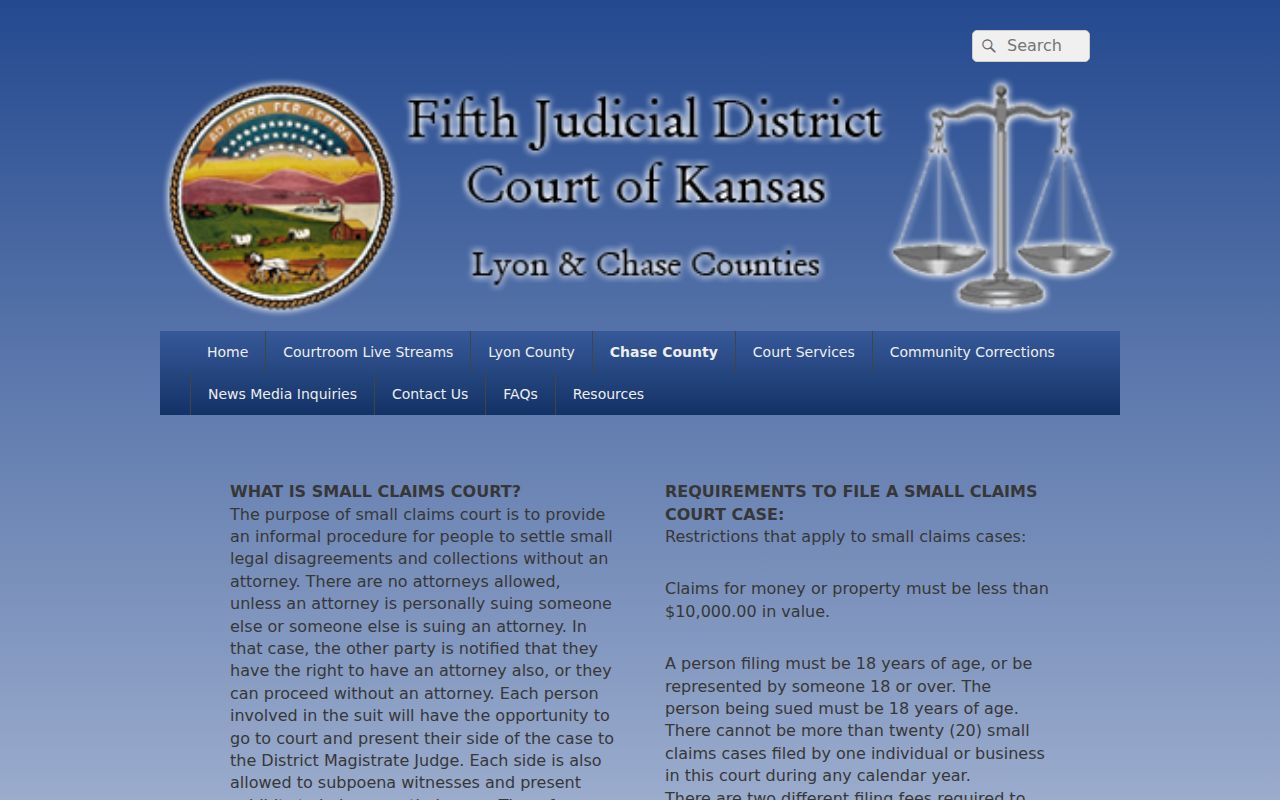
The official page connects the online guidance to the clerk-led filing path. It cannot substitute for confirming current fees and dates with the court.
| Item | Published amount or rule |
|---|---|
| Claim limit | Less than $10,000 |
| Claim up to $500 | $47.50 filing fee |
| $500.01 through $10,000 | $67.50 filing fee |
| Sheriff service | $15 per address |
| Witness | $10 plus mileage |
| Appeal | Written appeal within 14 days; page states a $195 filing fee |
Chase Civil Cover Sheets Stay Separate
Here is a common trap the Fifth District eviction materials explain. A Civil Information Sheet or Civil Cover Sheet may be required to open a case. Yet it can stay nonpublic, kept separately, and destroyed after a reasonable time. Required filing material does not automatically join the public docket.
Dates matter, too. The Chapter 61 eviction packet and a 2020 administrative order describe local procedure. One old rule set forcible-entry-and-detainer matters no fewer than three and no more than fourteen days after filing, plus remote hearings. Confirm current filing dates, service, fees, and remote availability with the clerk. Do not copy a dated order.
Hearings on the Civil Docket
The Fifth District's Chase calendar lists civil settings by date. It can include the judge, time, case number, setting type, role connections, and attorney fields. Search the newest PDF by case number. Read the whole setting box. The calendar updates daily. It can change, so confirm any setting with the clerk before you rely on it.
A reset, continuance, or cancellation can alter the scheduled event without deciding anything. For the full date workflow, see the Chase County court schedule. What actually happened shows up only in the official register and the later order.
FY2024 Chase Civil Filing Mix
Chase County logged 55 civil filings in fiscal 2024. The Kansas Judicial Branch breaks the count out across regular, limited, and domestic categories in its FY2024 civil filings report.
That figure counts fiscal-year filings. It says nothing about pending cases or how many separate litigants were involved. Even in a smaller county, careful filtering still pays off.
Who Can See Civil Dockets
Kansas Supreme Court Rule 22 decides what the public can see online. It governs a Chase County civil docket, too. Confidential family material, mental-health records, sealed files, protected identifiers, and nonpublic cover sheets stay off-limits. That holds no matter who asks. The Kansas Open Records Act does not override these court-specific limits. A courthouse terminal can show some public material that the online view leaves out.
When a CaseSearch result looks thin, go around it. Visit the clerk at 300 Pearl Street, call 620-273-6319, or mail a request to P.O. Box 529. Name the exact case and document. Then ask about a plain or certified copy and the current charge.
Key access rules. Rule 22 separates online, terminal, and restricted access. K.S.A. 45-218 addresses inspection and requests, while K.S.A. 45-221 addresses exemptions and redaction.
eFlex and the Chase Civil Docket
Kansas eFlex is built for authorized filers, not for public docket searches. A filing pushed through eFlex does not appear instantly in CaseSearch. The court has to process it first. Rule 22 still controls which documents and information may display remotely. Filers who need proof of acceptance should rely on the filing receipt and clerk confirmation. Public readers should watch for the later docket event instead. That separation keeps filing access and public record access in their own lanes.
The small-claims page walks through what happens after judgment. A judgment debtor has 30 days after the required statement is mailed to complete it or pay, and a written appeal within 14 days gets a new hearing before another judge. Those are the published local steps. Confirm current filing requirements and charges with Jenna Gibb before acting. A judgment never collects itself; garnishment or other collection filings later can add more docket events.
For any Chase County civil docket, read the event sequence rather than the caption. A petition might be followed by service or return-of-service entries, an answer, counterclaim, motion, response, hearing, journal entry, dismissal, or post-judgment filing. A plaintiff-and-defendant caption proves nothing about service, default, liability, or collection. The filed events answer those questions.
The clerk can supply records the portal view cannot. Use the courthouse public terminal, call 620-273-6319 for routing, visit 300 Pearl Street, or mail a focused request to P.O. Box 529. State the case number and the document you want. Ask whether a plain or certified copy is available and what it costs; an online screen is not official certification. Certification is a separate clerk service.