
Chase County Court Docket Searches
Start with Kansas Judicial Branch CaseSearch for any Chase County District Court case. Pick District first. Then search by case number, party or business name, or citation number. Choose Chase County when that filter pops up. If the name is common, add a case type and a filing-date range to cut the noise. The portal shares public case information only. It does not promise that every filed paper sits online.
Match the venue before you dig. A Cottonwood Falls city citation likely belongs to municipal court, not the district. A case numbered in the CS-2026-TR-000364 style belongs to the Chase district system. Federal matters live in PACER. Appeals sit in the Appellate choice. Write down the full case number, caption, court, and rough filing date before you search again.
- Open CaseSearch, accept the access terms, and choose District for a Chase County trial-court matter.
- Select the narrowest search type and enter the exact case, citation, party, or business term.
- Choose Chase County and add case-type or filing-date filters only when they help.
- Compare a listed hearing with the Fifth Judicial District calendar, then confirm it with the clerk.
- Use the courthouse terminal or request the exact document or certified copy when the web result is not enough.
CaseSearch Fields for Chase County
The CaseSearch form asks for a court, a search type, and a search term. A human-verification step comes with it. More filters appear once your search takes shape. Anyone can run a basic public search without an approved account. Registration exists for attorneys and other approved users who need broader access under Kansas rules.
| Field | Use for Chase | Practical point |
|---|---|---|
| Court | District | Use Appellate only after a case reaches that system. |
| Search Type | Case, party, business, or citation | A number is usually more precise than a name. |
| County | Chase County | This avoids results from other Kansas counties. |
| Extra filters | Case type, DOB, file dates | Use only what is needed and do not republish private data. |
A human check may appear before results load. If it stalls, or a result looks thin, skip the people-search sites. Use the public terminal instead, or call the Chase County District Court Clerk.
Court Dockets: What They Show
Think of a Chase County court docket as a timeline. It lists the court, the case number, and the public caption. Attorneys or roles come next. Filed events, hearing settings, and disposition entries round out the page. A setting is only a planned event. A motion label proves a request was filed or scheduled, nothing more. An entry may have paper behind it, like a judgment or order. That document may take a separate request to see.
| Case Number | Observed Chase formats include CS-YYYY-CR-NNNNNN, TR, CV, and a juvenile JC pattern. |
|---|---|
| Parties | Public names or entities may appear, while protected matters can display “Sealed.” |
| Docket Entries / Filings | A dated sequence of motions, notices, orders, judgments, and other case events. |
| Hearing Settings | Dates, times, setting types, and sometimes a remote-hearing connection. |
| Court & Judge | The venue and judicial officer tied to the case or setting. |
| Disposition | The recorded outcome, which is different from a calendar label or pending motion. |
Reading Chase Docket Terms
Short labels squeeze a lot of case data into a calendar or events index. Context matters when you read them. Chase calendar codes you see are observed formats rather than a complete local code legend.
- Setting
- A scheduled event. It does not prove that the event occurred.
- Continuance or reset
- A move to another date, effective only after the court approves it.
- Disposition
- The recorded resolution of a charge or case.
- Sealed
- A record or identity restricted by statute, rule, or court order.
- Certified copy
- A clerk-authenticated copy requested separately from the public search result.
Terms like arraignment, pretrial conference, plea hearing, sentencing, motion, or bench trial name the kind of court event. They say nothing about the ruling or the full facts. Read the related entry, or request the public document itself.
Chase County Courts and Their Dockets
Chase County District Court is the Kansas trial court of general jurisdiction here. It sits in the Fifth Judicial District. Lyon County sits there too. Municipal courts handle their own city ordinance and municipal traffic cases. Kansas appellate courts and the federal District of Kansas run separate systems entirely. Search the wrong tier. You may get nothing, even when the case exists.
| Court | Docket Covers | Where to Search |
|---|---|---|
| Chase County District Court | Criminal, civil, family, probate, mental health, traffic, and juvenile matters within its authority | CaseSearch, courthouse terminal, Fifth District calendar, District Court Clerk |
| City municipal court | City ordinances and municipal traffic or violation cases | Issuing city office; Cottonwood Falls has a municipal-court page |
| Kansas appellate courts | Appeals and original matters within appellate jurisdiction | CaseSearch Appellate option and appellate clerk |
| U.S. District Court, District of Kansas | Federal civil and criminal cases from the Topeka Division area | PACER, CM/ECF, or the federal public counter |
A Landmark With Modern Access
The courthouse that anchors Chase County government also serves as the physical fallback for the electronic docket system. The Cottonwood Falls courthouse history covers the 1873 building, its local limestone and walnut, and its continued public use.
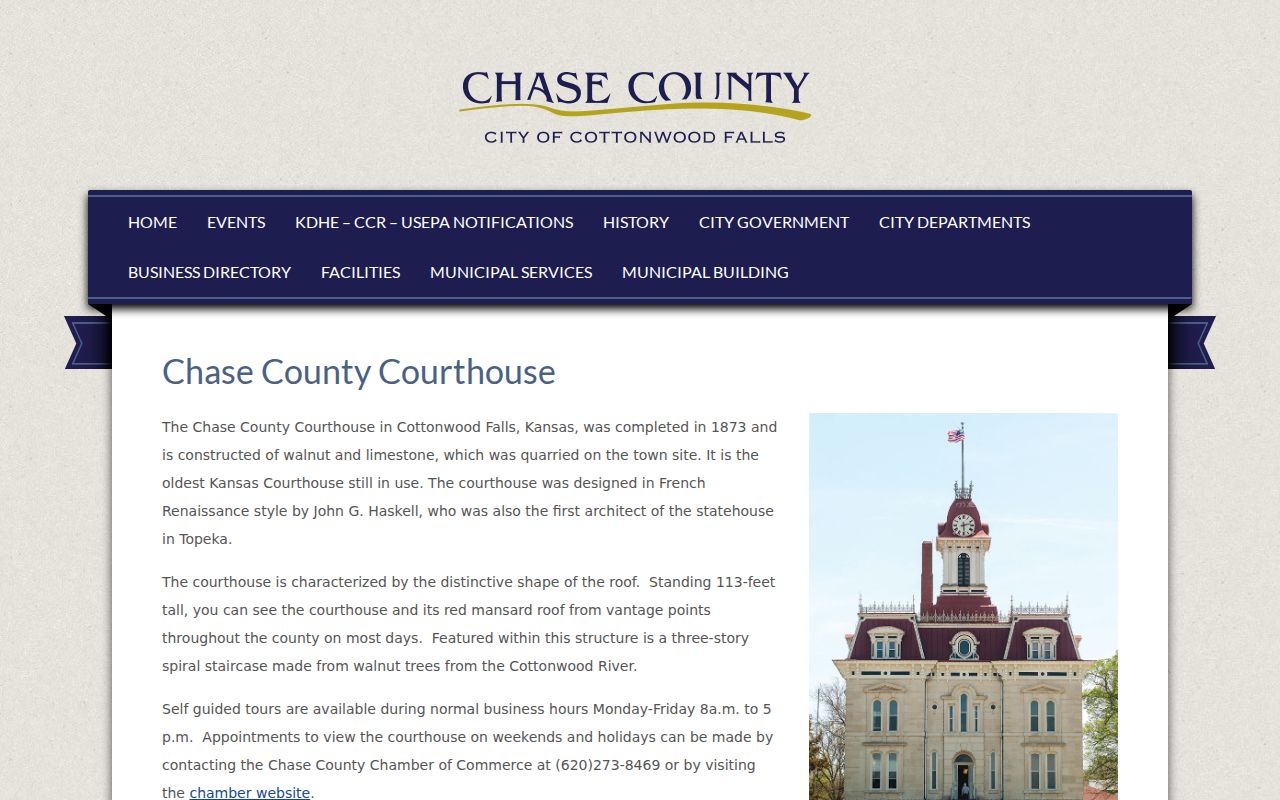
That history matters for a record search. The courthouse still holds the District Court Clerk's counter. The public-access terminal sits there too. Tour details do not mean a counter or courtroom is open for an unscheduled visit. The Kansas Historical Society listing offers a second official record of the courthouse's historic status.
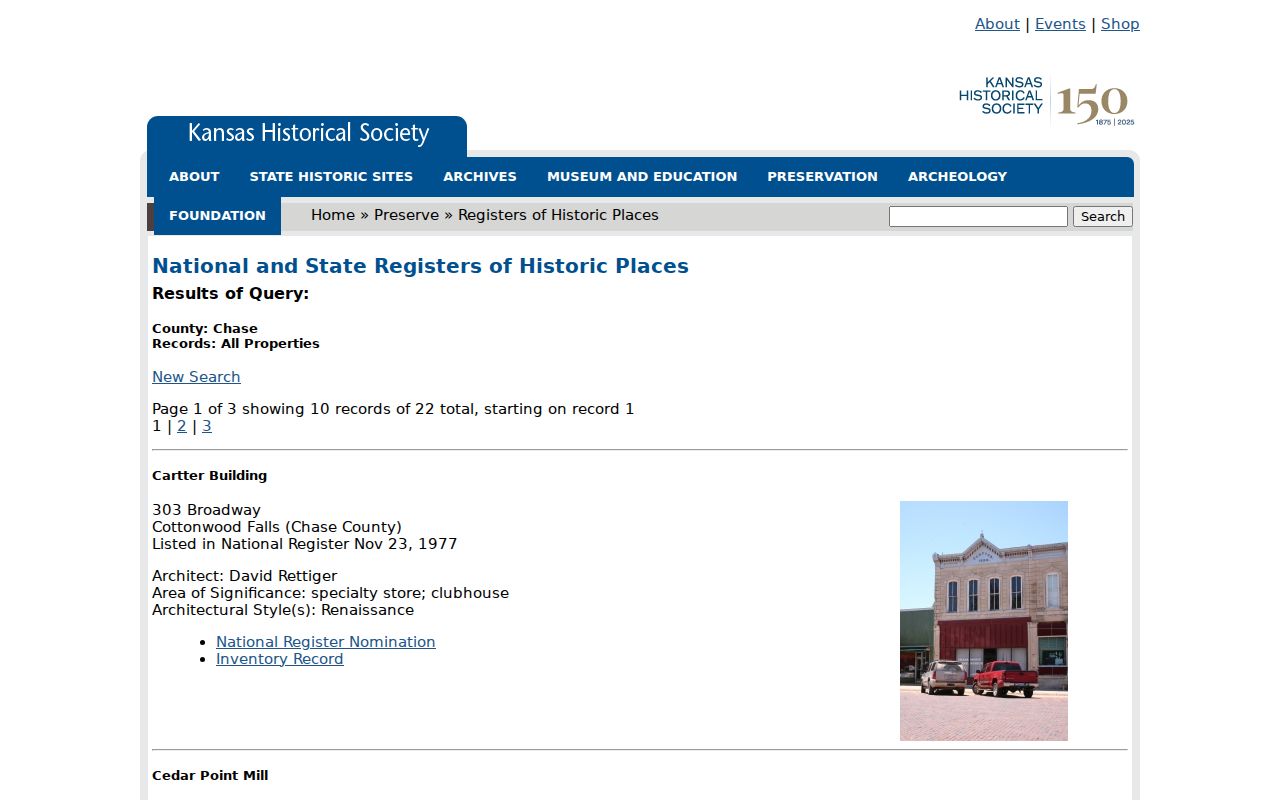
Historic recognition and court-record access serve different ends. The listing names the landmark; the clerk and Kansas Judicial Branch control access to case records.
Court Dates and Settings in Chase County
The Fifth Judicial District posts a Chase calendar covering roughly one month. An entry can list judge, date, time, case number, caption, and connection. Attorney, setting type, and a hearing connection may appear too. The PDF warns that it changes without notice. A scheduled sentencing does not prove a sentence happened. A motion setting does not prove the motion was granted, either.
Check the full Chase County court schedule, then call the clerk. Do that before you travel or join remotely. A continuance is not final just because the parties asked. Hearing-date requests follow the district's published coordination rules. They never replace a filed motion or notice.
When Online Results Fall Short
Rule 22 builds two layers of public access. The online portal shows only information approved for the internet. But every courthouse keeps a terminal with additional public case records and events. So a gap online does not mean no record exists. It may reflect restricted status or older coverage. It could be a search error, or material that lives only at the terminal. The Kansas Judicial Branch district-record explanation walks through the courthouse-terminal route. At 300 Pearl Street, ask the District Court Clerk for the reserved public computer. The exact terminal spot is not published, so a quick call first makes sense.
Web portal → courthouse terminal → clerk request is the practical Chase County access chain. None of those routes opens a sealed record.
From Paper Files to eCourt
Kansas now offers several ways into its courts. CaseSearch, a courthouse terminal, the Fifth District calendar, the Central Payment Center, and eFlex each do one job. CaseSearch carries public case information. The calendar lists planned settings, and the payment center takes eligible balances. For attorneys, eFlex handles electronic filing. It is not a public docket search.
Older Chase County records may still live on paper, in an archive, or as a reproduction. Rule 108 governs reproduction and retention, but digitizing every historic register is not something it promises. So ask the clerk what form a record takes, whether the public may see it, and what a copy or certification costs. The court posts no full Chase copy-fee schedule online.
Portal changes create their own traps. The Fifth Judicial District still hosts pages pointing to older public-access addresses or registration steps, even though current CaseSearch grants basic public access with no registration at all. Start from the current Judicial Branch address. If an old bookmark fails, that error is not a case result. The statewide status page or the clerk will settle the question.
Docket Access Under Kansas Law
The Kansas Open Records Act opens with a simple promise. Records belong to the public, within listed exemptions. Court access also runs through Kansas Supreme Court rules, sealing orders, redaction rules, and the law of the specific case. Ask for an identifiable record. And for a Chase District Court case, use the court custodian. Do not use the elected County Clerk.
Key Rules:
K.S.A. 45-216 states Kansas policy favoring access to public records unless law provides otherwise.
K.S.A. 45-218 supplies the core inspection and request procedure.
K.S.A. 45-221 lists exemptions and supports separating public material from protected content where practical.
Kansas Supreme Court Rule 22 governs portal and courthouse-terminal access to court records.
Sealed Labels Protect Identities
A public calendar can list a Chase County setting. But it may hide the party behind the word “Sealed.” The label means the case exists, nothing more. Adoption records, expunged criminal records, most juvenile and child-in-need-of-care records, grand-jury material, and anything closed by law or court order stay closed. That holds even though a case number or setting appears in public. Do not try to rebuild a protected identity. Pairing a date, judge, town, or role with outside clues crosses the line. Ask the clerk instead whether a public or redacted portion can be released. A party or authorized participant may have a court procedure for access. KORA itself does not unseal a court record.
Key distinction: portal absence is not proof that a person has no case, and terminal access is not a back door into a sealed file.
Calendar, Docket, or Document
Three public resources answer three different questions. The Chase calendar shows what is planned. A docket or events index shows what has been entered in the case chronology. A filed document holds the actual text behind an entry. A fourth item is the certified copy. The clerk authenticates it for uses that demand proof of authenticity.
| Resource | Best use | Limit |
|---|---|---|
| Court calendar | Check an upcoming date, time, judge, or setting type | Subject to change and not proof of the outcome |
| Docket or events index | Follow the order of public filings and court actions | May omit protected content or the document text |
| Filed document | Read the public order, motion, notice, or judgment | May require terminal access or a clerk request |
| Certified copy | Obtain a clerk-authenticated public record | Requires a separate request and current fee quote |
Those distinctions stop common reading errors. A calendar line marked “Sentencing” does not state the sentence. An events-index entry marked “Judgment” does not hand you every page of the judgment. And a payment balance is no substitute for the court docket. Match the source to your question. Then request the underlying public record if you need more.
How the Clerk Keeps Docket Records
Jenna Gibb, Clerk of the District Court, keeps the Chase state trial-court records. Her office receives and indexes filings. It maintains docket events and answers public-terminal questions. It issues eligible copies and confirms current settings. It cannot give legal advice. It cannot open a sealed record, invent a record never filed, or promise a month-long calendar will hold still.
Put any written request on firm footing. Name Chase County District Court. Give the case number or caption, and identify the exact event or document. Say whether you want a plain or certified copy and how the office should respond. Ask for a fee estimate too, because no complete local copy schedule has been published.
Chase County District Court Clerk
300 Pearl Street, P.O. Box 529
Cottonwood Falls, KS 66845
620-273-6319
Monday-Friday, 8:00 a.m.-5:00 p.m.
The Courthouse Access Chain
The Chase County government page confirms the courthouse address and general public contact.
For a judicial docket, ask the District Court Clerk. The elected County Clerk is a different office. Both sit inside county government, but each keeps different records.
- District docket or filed court paper: District Court Clerk.
- County administration, election, or tax record: elected County Clerk.
- City ordinance citation: issuing city office or municipal court.
- Eligible traffic balance: Central Payment Center or clerk channel shown on the citation.
- Federal case: District of Kansas Topeka Division and PACER.
The National Park Service courthouse asset documents this civic landmark through a national source.
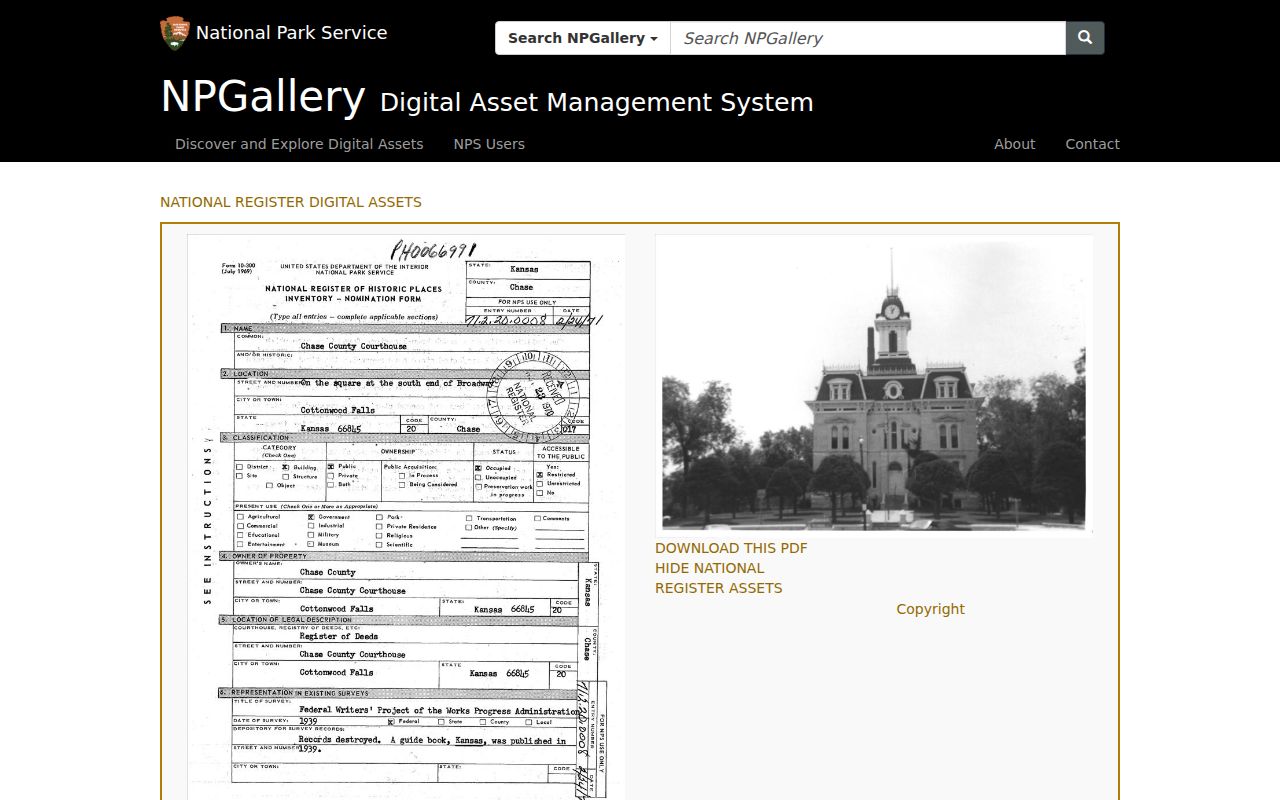
The building is nationally recognized, and it houses the modern terminal and clerk counter. Official court sources still control record access.
City-by-City Court Dockets in Chase County
Chase County has five incorporated places in the Census ranking behind these profiles. Cottonwood Falls publishes a municipal-court page. Strong City, Matfield Green, Elmdale, and Cedar Point post no official public municipal docket portal, though that is not proof a city court or paper record is missing. A city citation begins with the issuing office. A Chase district case number moves to CaseSearch and the District Court Clerk.
The Census incorporated-place table supplies the population order.
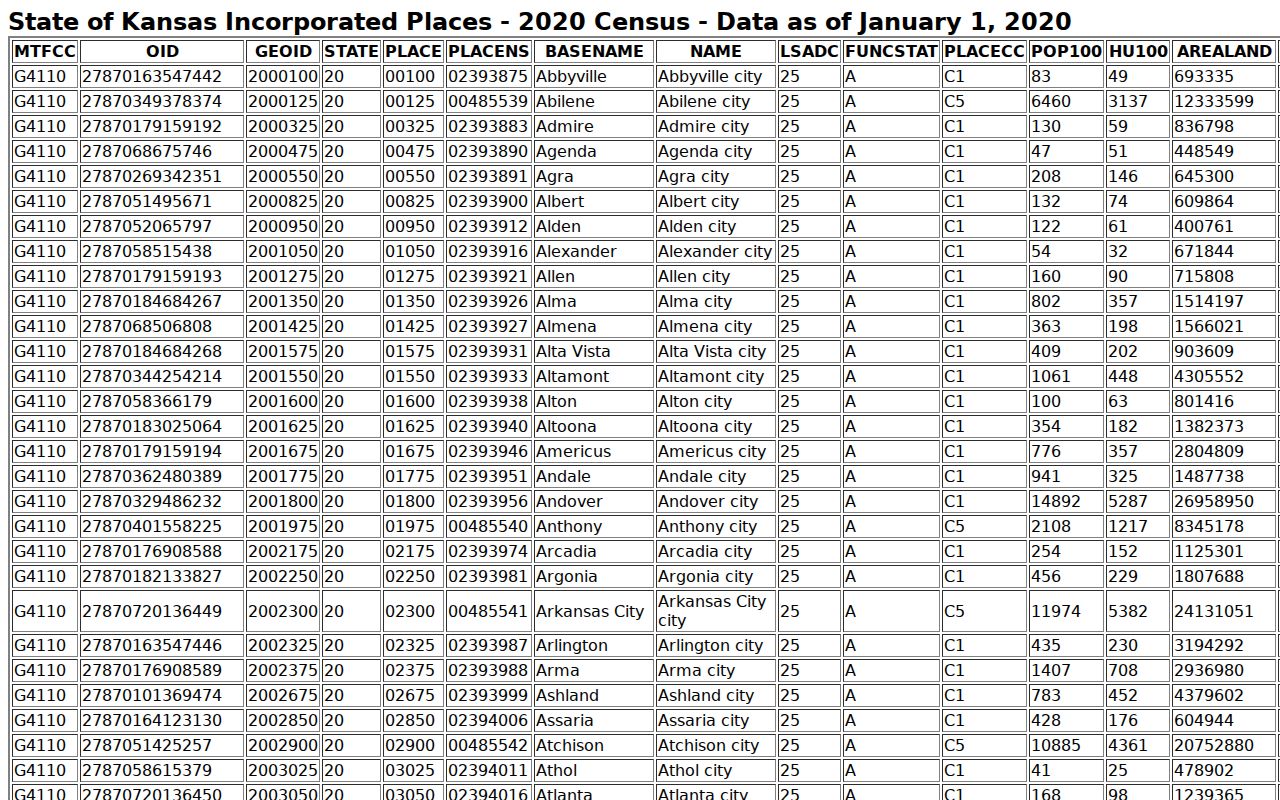
The population table sets the order of the city profiles. It measures no caseload and proves no portal exists.
Cottonwood Falls Court Records
851 · Official municipal-court and ordinance pages provide the local first route.
Strong City Court Records
386 · City Hall is the documented routing point; no public docket portal was located.
Matfield Green Court Records
49 · The municipal profile gives a direct city contact and limited office schedule.
Elmdale Court Records
40 · The official city contact form routes questions but is not a docket search.
Cedar Point Court Records
22 · The municipal profile and citation instructions provide the first local route.
Map and Directions to the Chase County Courthouse
Chase County District Court records are kept at the historic Chase County Courthouse, 300 Pearl Street, in Cottonwood Falls. Completed in 1873 of local walnut and limestone in a French Renaissance/Second Empire style, the building is listed on the National Register of Historic Places and still houses the working District Court Clerk's counter alongside county-government offices. A drop box sits at the courthouse's southeast corner.
Chase County District Court Clerk
300 Pearl Street, P.O. Box 529
Cottonwood Falls, KS 66845
620-273-6319
Monday-Friday, 8:00 a.m.-5:00 p.m.
Ask for the District Court Clerk rather than the elected County Clerk, since both share the courthouse. No official page publishes security-screening, parking, or ADA-entrance instructions, so call 620-273-6319 ahead of a visit for an accommodation or a public-terminal appointment.